20 March 2007

Berlin pics Part One

Berlin Day One


As per usual, click on the picture above and it will connect you to the google photos site, where you can view all of the photos from the trip.
We have arrived in Prague last night, another spectacular city in Europe. We were in Dresdan yesterday, which was the city that was hit the hardest by the allies in WWII. I will upload some great photos from there as soon as I can, but for now, enjoy all that we got to see in Berlin, which actually is only a fraction of all that there is to see in Berlin. Read more!

16 March 2007

In Berlin

We arrived in Berlin in the afternoon yesterday, via Lili's little yellow Renault. The drive from Koln to Berlin took about six hours, two of which I drove on the famous Autobahn speedway. I was a little unnerved at the driving habits of the Germans at first, but I think most of that was directly attributed to the looseness of the steering in the car. I am not used to such flexibility in the steering, which made for a few nervous moments behind the wheel.
The cars move at a good click, and they pay attention to the policy which used to exist in the states that the far left hand side is the speeding and passing lane and the two right lanes are for more traffic volumes. This makes things much easier to handle. You really have to pay attention when moving in and out of the speed lane as cars can be traveling upwards of 200kg a hour... but even if you do seem to make a mistake, the people don't give you the finger or are aggressive in any way, they may simply give a courtesy honk and move on...
As we arrived in Berlin, our moods improved greatly. The city itself is by far the biggest that we have been in thus far. I am not even sure what part of town we are staying in, but its a hostel, which is still 50 bucks a night for a private room. The area looks a bit dodgy, but then again, most of the town looks dodgy, but its Berlin! I don't really expect to not see many parts of town that don't have a slightly rundown look to them. Graffiti is a major problem all over Germany and I wonder why they don't prosecute these people for their "art". People need to begin to speak out against this shit, but Lili tells me that they do try to do what they can, but they are sneaky fuckers!! (I should also mention that it was a problem in Holland as well, and I expect to see it in Prague.) I remember that the Berlin wall, when it was brought down years ago, it was also covered in graffiti as well.
The hostel is located inside of an old former factory it would seem, called Die Fabrik. I am not sure if I love it just yet, but it seems semi quiet, but the silence is almost a bit weird.
I have a lot of thoughts of the war these days. Faint echoes from the courtyard of men shouting in German make me think of that horrible time in European history. Today we will make our way to Checkpoint Charlie and possibly to the concentration camp where Anne Frank was murdered. We are talking about going to Auschwitz, but I think that Dresdan is a more viable option. Dresdan has always had a lot of meaning for me as it is where Slaughter Haus 5 is set...
So it goes.... Read more!

14 March 2007

Dave and Tim Köln EWerk

Here are the pictures from last nights show with Dave and Tim. Check out www.youtube.com/hoggenstein
for the videos, which I am trying to post as time allows. Currently, there are thee great versions online and ready for your consumption.


Dave and Tim Koln EWerk
Read more!

13 March 2007

Amsterdam

Well, Amsterdam was just awesome.
Stories and stuff are to follow...
For now, here are the pics for you to enjoy. Simply click on the pic to see all of the pics from Amsterdam.

Cheers....


Amsterdam
Read more!

10 March 2007

Germany Part 1


Clink on this link to be taken to the picture gallery of the European vacation!!!
We are off to Amsterdam tommorow for three daze.... Read more!

09 March 2007

The travelling is always the hardest part...


5:14pm Happy Hour, JFK
March 7, 2007
Journal entry number one.. I am here at JFK, my phone isn’t working because my sister had it shut off because she doesn’t want to have to worry about roaming charges, even though she owes me fifty bucks. Sad, really, but the last thing that I want to do it further complicate our relationship by bringing up yet another moment of disappointment. She has had a lot of them lately and yet her faults seem to be directly attributed to my faults.
As you can probably tell, I am not in the best of sprits for starting out my vacation. I always find it especially weird to be in these airports, people watching. It sort of makes me sad at the sight of the human race-the last flight was anything but pleasant… This is what airtravel is going to be like for the next yet to be determined chapter. It’s the worst—it almost seems anti travel the way that they handle things—I would love to visit so many places, but flying to the places just sucks. I can remember not so long when it wasn’t like this, when it didn’t seems like everyone in the entire world wasn’t travelling. Now, you get on and the flights are full, they feed you fucking crackers and call it good. Totally unacceptable, but what are you going to do?
But anyway, this is the thing. Its not about this part, its about the other side. Its about my arrival in Germany, its about relaxing and chilling out. It just goes to show that in reality I need to move on with my life, get the fuck out of the states and see what its like on the other side. I am crazy looking forward to seeing Lili and make things happen again, its been so tough for her, and difficult for me as well, but at the same token I have noticed that I have this ability to compartmentalize my feelings much more. A that I know is that I am a smart guy and I have had seen more success from my time abroad than my time in the states, so I am not sure.
This is a rather stressful trip as well, one that I am looking forward to the challenges, but at the same time, I am up for the challenges that lie ahead… (more on that later) FUCK, if I sit and think about it for a minute, I really start to think about how much I have on my plate for the next chapter and how I need to balance it all… but, at the same time, this latest journey is going to be one that is totally about perspective.
General vibe: Nervous and Anger. My sister has still not even acknowledged what is going on and she knows. Sad.
1:45 Business Class Air France
Fuck.
So, the flight from JFK to Paris was three hours late in taking off. Perhaps this could have been mitigated if we had not already loaded the plane to capacity and then some kid gets an allergic reaction because he ate a peanut. As a little heads up from me to you, when a passenger gets on a plane and then gets off, his luggage has to go with him (including what is checked). So, somewhere, some kid owes me 3 hours, not only that, he owes about 335 people three hours.
I am not a small man, I have come to terms with it, except when I fly. Never do a feel like I need to enter a weight loss program more than when I have to squeeze into one of those tight fitting seats. This time was a particular challenge as I seemed to have developed a pocket of fat which seemed to rub perfectly with the oncall oh shit button. Twice during my slumber I was awakened with that ever so not meant to be invasive tap, tap tap.
“Sir, did you need anything?”
No, but perhaps my fat deposit does. Do you have a deep fried twinkie? Perhaps a nice peanut butter and banana sandwich?
Friday noon.
I arrived six hours later than anticipated, due to the issues discussed in the previous entries. This turned out to be just fine as I was eventually able to reach Lili in Paris and let her know what had happened. Seeing her on the other side of the baggage claim made all the anxieties of the last weeks go.
Germany: Interesting. From the moment that we left the confines of the baggage claim and entered the autobahn, my American box that we all seem to live in began to break itself down. I looked out of the window at all of the different cars that surrounded us—a plethora of Mercedes and BMW’s that I had never seen before, along with a wide variety of science convention protypes that will more than likely never be seen in America.
Lili was nothing short of amazing, as she always is. As she was weaving in and out of the traffic, our eyes caught the occasional gaze of one another. What an exciting moment these times of my life are. Exciting things are coming for sure.
We came home and took a nap, curled tightly against each other and I passed out. Upon waking, we picked her mother up from the train station and went to dinner, which I took a pic of the pub. We had a couple of beers, breaking the ice and the language barrier at the same time. Dinner was wonderful, some of the best food I have had in quite some time—and certainly the best I have had in a bar in ages.
I want to apologize if the beginning of this journal has no flow in it—I am still very tired and a bit rushed. More to come. Read more!

06 March 2007

Hogg is in Seattle *last night

So, my mom is out of surgery... and I am about 15 hours away from leaving for Germany. I can't begin to put down in words the kinds of things I have gone through in the last months without Lili here, there simply hasnt been enough time but to do anything and work, work, work. But the time has paid off and I am not preparing for a three week journey.
Here is the itenerary:
Arrive Thursday morning, Dusseldorph. I arrive, Lili picks me up, the love story continues. We are in Koln most of the week, hitting a football match on Friday or Saturday, then its off to Amsterdam for the weekend, heading into the week.
Then back Tuesday for Dave Matthews and Tim Reynolds in Koln.
Then, by next weekend, we make our way to Berlin, Nuremburg and finally to Prague.
Stay tuned, there are some major developments being put into motion... Read more!

24 February 2007

China locks up online "addicts" for harsh rehab

China locks up online "addicts" for harsh rehab
By Ariana Eunjung Cha

The Washington Post

He Fang, 22, says incessant online gaming hurt his grades. He says he's been changed by his stay at the military-run clinic at Daxing, one of eight such Chinese facilities to treat Internet addiction.

DAXING, China — Sun Jiting spends his days locked behind metal bars in this military-run installation, put there by his parents. The 17-year-old high-school student is not allowed to communicate with friends back home, and his only companions are psychologists, nurses and other patients. Each morning at 6:30, he is jolted awake by a soldier in fatigues shouting, "This is for your own good!"

Sun's offense: Internet addiction.

Alarmed by a survey that found nearly 14 percent of teens in China are vulnerable to becoming addicted to the Internet, the Chinese government has launched a nationwide campaign to stamp out what the Communist Youth League calls "a grave social problem" that threatens the nation.

Few countries have been as effective historically in fighting drug and alcohol addiction as China, which has been lauded for its successes, as well as criticized for harsh techniques.

Now the country is turning its attention to fighting another, supposed addiction — one that has been blamed in the state-run media for a slaying over virtual property earned in an online game, for a string of suicides and for the failure of youths in their studies.

The Chinese government in recent months has joined South Korea, Thailand and Vietnam in taking measures to try to limit the time teens spend online. It has passed regulations banning youths from Internet cafes and has implemented control programs that kick teens off networked games after five hours.

There's a global controversy over whether heavy Internet use should be defined as a mental disorder, with some psychologists, including a handful in the U.S., arguing it should be. Backers of the notion say the addiction can be crippling, leading people to neglect work, school and social lives.

But no country has gone quite as far as China in embracing the theory and mounting a public crusade against Internet addiction.

To skeptics, the campaign dovetails a bit too nicely with China's broader effort to control what its citizens can see on the Internet. The Communist government runs a massive program that limits Web access, censors sites and seeks to control online political dissent. Internet companies such as Google have come under heavy criticism abroad for going along with China's demands.

In the Internet-addiction campaign, the government is helping to pay for eight in-patient rehabilitation clinics across the country.

The clinic in Daxing, a suburb of Beijing, the capital, is the oldest and largest, with 60 patients on a normal day and as many as 280 during peak periods. Few of the patients, who range in age from 12 to 24, are here willingly. Most have been forced to come by their parents, who are paying upward of $1,300 a month — about 10 times the average salary in China — for the treatment.

Led by Tao Ran, a military researcher who built his career by treating heroin addicts, the clinic uses a tough-love approach that includes counseling, military discipline, drugs, hypnosis and mild electric shocks.

Tao said the clinic is based on the idea that there are many similarities between his current patients and those he had in the past.

In terms of withdrawal: "If you let someone go online and then he can't go online, you may see a physical reaction, just like someone coming off drugs." And in terms of resistance: "Today you go half an hour, and the next day you need 45 minutes. It's like starting with drinking one glass and then needing half a bottle to feel the same way."

Located on an army training base, the Internet-addiction clinic is distinct from the other buildings on campus because of the metal grates and padlocks on every door and the bars on every window.

On the first level are 10 locked treatment rooms geared toward treating teen patients suffering from disturbed sleep, lack of motivation, aggression, depression and other problems. Unlike the rest of the building, which is painted in blues and grays and kept cold to keep the teens alert, these rooms are sunny and warm.

Inside Room No. 8 are toys and other figurines that the teens can play with while psychologists watch. Room 10 contains rows of fake machine guns that patients use for role-play scenarios that are supposed to bridge the virtual world with the real one.

Room No. 4 is made up to look like home, with rattan furniture and fake flowers, to provide a comfortable place for counselors to talk to the teens. Before meeting with a patient, one counselor swapped her olive-hued military uniform for a motherly cardigan and plaid skirt.

Among the milder cases are those of Yu Bo, 21, from Inner Mongolia, and Li Yanjiang, 15, from Hebei province. Both said they used to spend four to five hours a week online and their daily lives weren't affected, but that their parents wanted them to cut their computer usage to zero so they could study. Yu said he agreed to come because he wanted to train himself. Li said it was because he just wanted to "get away from my parents."

Perceived as a more serious case is that of He Fang, 22, a college student from the western region of Xinjiang. The business-administration major said his grades tanked when he started playing online games several hours a night. The clinic "has mainly helped me change the way I think," he said. "It's not about getting away from pressure but facing it and dealing with it."

Before Sun, the 17-year-old, who is from the city of Cangzhou, checked into the clinic about a month ago, he said, he was sometimes online playing games for 15 hours nonstop. "My life was not routine — day and night I was messed up," he said.

Since he's been there, Sun said, he's decided to finish high school, attend college and then work at a private company. With the help of a counselor, he's mapped out a life plan from now until he's 84.

No one is comfortable talking about the third floor of the clinic, where serious cases — usually two or three at a time — are housed. Most have been addicted to the Internet for five or more years, Tao said, are severely depressed and refuse counseling. One sliced his wrists but survived. These teens are under 24-hour supervision.

Tao said he believes 70 percent of the teens, after one to three months of treatment, will go home and lead normal lives, but he's less optimistic about the third-floor patients. "Their souls are gone to the online world," he said.

Guo Tiejun, a school headmaster turned psychologist who runs an Internet-addiction research center in Shanghai, said the military-run clinic goes too far in treating Internet addicts like alcohol and drug addicts.

He said he has treated several former patients of the Daxing clinic and that one mother told him it was simply "suffering for a month" that did not help her son. Guo said he believes the root of the problem is loneliness and that the most effective treatment is to treat the teens "like friends."

"Our conclusion is that kids who get addicted in society have some kind of disability or weakness. They can't make friends, can't fulfill their desire of social communication, so they go online," Guo said.

Guo is especially critical of the use of medications — which include antidepressants, anti-psychotics and a variety of other pills and intravenous drips — for Internet addiction because, he said, that approach treats symptoms, not causes.

Tao and his team of 15 doctors and nurses defended the treatment methods. He said that while some clinics depend wholly on medications, only one out of five patients at the Daxing clinic receive prescription drugs. Tao did agree with Guo that Internet addiction is usually an expression of deeper psychological problems.

"We use these medicines to give them happiness," Tao said, "so they no longer need to go on the Internet to be happy."

Still, for all the high-tech treatments available at the clinic, the one Sun says helped him most was talking. He looks forward to returning to school and getting on with his life.

The first task on his agenda when he gets home: get online. He needs to tell his worried Internet friends where he was these past few weeks. Read more!

18 February 2007

German Countdown

Germany Trip has been confirmed.
March 7th through the 26th.
Mostly going to see Lili, but as of right now, two side events are scheduled.
Dave Matthews live in Koln on the 12th of March
Nine Inch Nails on the 13th of March.
So, all in all, its looking to be an exciting trip just from the live concert experience.
If anyone has any ideas, please feel free to leave a comment. We are planning to go and tour the castles of the North and touring some of the Nazi sites inside of Germany. We have also planned to perhaps make a journey to either the Netherlands or perhaps Prague, but this is largely dependant upon cheap flights.

The total cost of the airline ticket is 563.00 round trip on Delta! A good price, but not the best airline. The good news is that they are partners with my mileage plan! Read more!

03 February 2007

LONG TIME.

Again, I find myself writing to explain why I havent written.
Things are crazy right now, but I am hoping to put an end to that in the near future. Writing is very important to me and keeping this thing going is a part of that importance.
I have had to spend much more time on the computer getting it to the point where I can really start working on the materials has been a struggle, but in the end the housecleaning I have been doing will aid the process much better once that time comes.
I have upgraded to Vista and it is working quite well. There have been a few major glitches which I have now managed to fix. The other project that has been taking up a lot of my time is arranging music and other media related things in a format which is easy to catalog and access. I tend to listen to a lot of music and have so much of it that if it isnt catalouged correctly, it is a nightmare.

SO, that's where we are. Read more!

01 January 2007

Happy new Year!! 2007

Well, another year has passed, the 33rd year of my life.
So many things happened in the last year that my mind is still reeling from all that took place.
Some notable moments:
1. Spending half of the year mostly in China, but also exploring Lao, Cambodia and Thailand.
2. Bangkok
3. Meeting the love of my life, Lilifer Behrends, of Germany in Beijing while being visited by Billy and Virgia Bryant of Yellowstone Park fame.
4. Coming back to the United States and finding a contract job with Microsoft which will hopefully allow me to get ahead in the rat race and save enough for the possibility of an upcoming wedding.
5. Lili visiting Seattle while I am starting to get everything in order.
6. Work has begun on what will be my first book. (www.notsoredchina.blogspot.com)

Most of these things are in direct relation to my time in China. I think it represented a huge turning point in the way I view certain things, but time will tell.

The plan for 2007?
For the most part-- working.
This contract is hourly based with overtime, which allows for plenty of money to be made and there are lots of bills out there that need to be paid. These two things go hand in hand.
In my sparetime, I will be working on the 1st draft of the book and saving up for my visit to Germany in March to see Lili. From there, we shall see.
So for now, a very merry new Year to you all. Read more!

25 December 2006

Merry Christmas!

First off, I hope all of you are having a Merry Christmas!
I am at work right now, earning lots of cash for working. The only downfall is that they have forgotten to order the Christmas Dinner, which is crap, but I am not surprised.

If youre looking at this site for the first time, please excuse the mess!
I am currently in the process of transistioning all of the content that has to do with China into another part to begin the tedious process of editing for a book which I have always dreamed of putting together. Countless hours of writing and taking in a year in China is the premise of what the book is going to be about--and I have given myself the next six months to get everything together in a first draft.

Anyway, please enjoy and make comments as needed. Read more!

18 December 2006

Nature, the ultimate rage against the machine.

All I can say is wow.
Since coming back from China, I have been continually amazed how we live here, especially when we as a society are faced with a dilemma, which is much the case now here in Seattle.
For those of you who don't know, Seattle was whacked for the second time this season, but this one with an intensity that none of us has seen in sometime. Microsoft lost of all its power in the Seattle area and was unable to function. I work for the MSN OPS Center, which is the certralized hub of all issues related to the Microsoft Network. We were relocated to another site in South Seattle because the generator power at MS was not enough to handle the routers and other equiptment that are essential to our core business.
All of it at the mercy of mother nature.
Its hard to not think about everything that the country has and how little response time we have when it comes to disaster. Its also not difficult to think about Katrina and the lack of response of that and contrast it to this--where its all hands on deck and people working around the clock to make a difference. Everyday progress is made and continues to be made until the power is restored and people are on their way back to normality.
Then, there is China, where if a tragidy occurs, the government either downplays the issues or they cover it up.
Anyway, thats my side. Read more!

05 December 2006

So, this is the way that it works.


Days usually begin preciesly at 830 in the morning.
I sit up, recall waiting for the moment for quite some time
nod a few times
and begin my day.


At least four days out
the standard seven in the same way
I get up and move closer
to my death


these days theres no such thing as silence
and no time to get out there and write something so big, so immense that it makes you think....


If I could change the world
Just stop watching TV
and youll have time to read
make change
and propose a soloution to all this
choas.


There was a choice that you just happen to make at some point. When I came back from college, it was finally done. I had put in my time and made it a good time, in both senses of the word. Now, I wanted to do something with it. Not so much make money, but get involved in something where you are helping to progress someone in society. Now when I say that, it might sound wierd, but its not.
This is how I fell into Chinas grasp. Read more!

26 November 2006

Content added to youtube.

I also have uploaded some utube content....
Search for it at www.youtube.com under the name hoggenstein.
Although I am responsible for the content, I am warning you that you might not find it funny. There will be many more uploaded in the coming days, so please check back. I am hoping that there is a little fun for everyone. Read more!

Anticipated completion date is set for 05/25/2007

So, this evening I decided to stay home and begin to organize my thoughts and actions around finally sitting down to begin putting all of the information needed to write this book about China. I spoke to a publisher *who will not be named, so dont ask*, and they said that the want to see a complete first draft on the book in 6 months.
If they like it, then we proceed to another draft. We are aiming for something published by this time next year--if I can finish the first draft.
So, for those of you check this thing on occasion, heres the deal....

I am going to turn this into a journal again, where I check in and do a few warmups to get into the write state of mind. I will update on progress, etc.

I have uploaded a bunch of content to youtube.com as well of most of my adventures in China. Some of them are totallz dull, but I dont have video editing software, so try to struggle through a couple of them and let me know what you think... You can search them by my username, which is Hoggenstein.

Ok, well, much time has been taken tonight, it nearly 2am and I must get some sleep in before spending yet more time infront of this thing, chasing a dream.

--talk soon. Read more!

23 November 2006

Thanksgiving--rememberances

In honor of today's Thanksgiving, I thought it might be a good idea to go back in time one year ago today and remember what will always live in my memory as the strangest, yet most personal thanksgiving ever. Although this journal entry, which I have printed below is just a small example of how I felt that day, looking back on the memory it was an exciting time. One thing about the chinese that always interested me more than anything else was how they managed to get as excited as young children over the western holidays with which they had so little familiarity. Today is bound to be equally as special as it is Lili's first thanksgiving as well and I think she, like the Chinese, is equally excited to see whats in store, to feel that holiday cheer that comes with all of these winter like holidays. I had a lot more to say in the previous entry that was swallowed up by cyberspace when the computer decided to go into hybernation and not save the information....

This brief moment is somehow more intimate than the last entry. Wherever you are in the world, I hope you take a moment to be thankful for something. And now, a moment from a year ago today....


Thanksgiving 2005..... To my shock and amazement, today was actually a great thanksgiving. Its over at about the same that every other thanksgiving is over, about 900pm, I am tired from all the food and activity that the day had brought forth. As per usual with Chinese festivities, I wasn't made aware that anything special was going to be happening until just after 10 this morning, when one of the cute chinese girls calls me and asks me if I can attend a special dinner and performance. I had known that the finals of the University singing/lipsynching to the worst English songs known to man was scheduled, but I had no idea that it would hold what we were in store for. I will upload some pics tommorow, but the food was horrid at first. I ate most of a frog before I finally asked what it was, and the fish, which I took a picture of, was made in my honor, so I was forced to eat it. Not good-as you will see. Then, I was told about 430 this afternoon, that I was going to be performing in the middle of the show, so again, I performed a SONG in front of 2,500 people. The song, thank god, was my choice. I chose, The Scientist, by Coldplay. I had three bouquets of flowers thrown to me for my excellant job in performance. Pics tommorow.... Read more!

08 November 2006

Chinese Thirst for Petrol

IN BEIJING NEXT WEEK, leaders of 48 African countries will converge for the largest international summit in modern Chinese history. Many will go home with what they came to collect: rich incentives to sign deals trading away their natural resources to China.
China's fast-growing economy has created a deep thirst for oil that has pushed it to do business with some of the most corrupt and dangerous regimes on Earth, several of them in Africa. The continent now accounts for 30% of China's oil imports, and growing. The widening trade isn't all one way -- Africa is becoming a market for Chinese consumer products -- and it isn't all harmful for Africa's impoverished people. Some Chinese investments are giving birth to beneficial new industries in Africa.
Yet Beijing's guiding philosophy of noninterference with the affairs of other nations, and its growing financial involvement in the developing world, are having an overwhelmingly negative effect on stability and human rights. Setting aside China's stonewalling on efforts to crack down on nuclear threats posed by Iran and North Korea, its reluctance to impose tough sanctions on Sudan (where it has significant oil interests) is contributing to the ongoing murder, rape and displacement of hundreds of thousands of people in the Darfur region.
As World Bank President Paul D. Wolfowitz pointed out in a recent interview with a French newspaper, Chinese banks also have increased lending to poor African countries that had been granted debt relief by industrialized nations, meaning they might once again be trapped under crushing debt loads.
And Chinese banks haven't signed on to the Equator Principles, a voluntary set of environmental and human rights guidelines adopted by 80% of the world's commercial lenders. This makes it easier for Chinese banks to do business with corrupt government officials. Alas, by propping up corrupt regimes while raiding Africa of its resources, China is doing nothing that Europe and the United States haven't done, which is why pontification from the likes of Wolfowitz rings very hollow in Beijing. Nonetheless, China's policies in Africa are bound to lead to a dead end.
Banks didn't adopt the Equator Principles entirely for altruistic reasons. As China becomes more deeply invested in Africa, it will discover that corruption, instability and environmental degradation lead to failed projects, stolen assets, intense public resentment and financial liabilities.
Respect for human rights has never been at the top of the agenda for communist Chinese leaders. But there are more hardheaded reasons for a change in course. China is in grave danger of repeating the West's money-losing mistakes. Read more!

College Degrees Lose Their Magic in China; Graduates Flood the Job Market;

Lai Chuanlong frowned anxiously as he waited his turn among the hordes of recent college graduates, all jostling for a chance to sit on a folding chair opposite a recruiter from a local company.
Tall and slim, he held his shoulders erect as a protective barrier against those with designs on cutting in front. He was concentrating on the objective at hand -- gaining a place in the white-collar world that only last year seemed guaranteed for a holder of a college degree in modern-day China.
No longer. This recent job fair in this city on China's east coast turned out to be a trading pit of disappointment and dashed dreams. Like many of the thousands of other graduates here, Lai, 24, was the first in his family to attend college, the son of illiterate villagers who borrowed heavily to pay for his education. It seemed a no-risk investment in a brighter future. Two months after his graduation, however, prospects remain bleak. Other than a brief stint as a factory laborer and a job offer at a supermarket for about $2 per day, Lai has found no work. At the job fair, he added his resume to piles of them, hoping to secure a job that pays $100 a month.
"Going to college was my dream, but the pressure to find a job is getting intense," Lai said. "I'm getting more and more nervous."
Throughout the world's most populous country, a dramatic surge in the number of college graduates has created fierce competition for the relatively high-paying office jobs that were once conveyed almost by right to anyone with a university degree. Where once college graduation ensured passage into the ranks of a privileged elite, this year it became a gateway to worry, diminished hopes and the prospect of unemployment -- the result not only of larger class sizes but also of lowered educational standards at newer institutions.
The spread of free enterprise into every crevice of once-Maoist China has unleashed a wave of for-profit private colleges that cater to those denied admission to established universities. They charge tuitions exorbitant by traditional standards for degrees that are proving of limited value. All of this has intensified labor pressures in a society struggling with its transition to a market economy.
The stress and uncertainty now plaguing China's best and brightest, a group conditioned by years of growth to anticipate upward mobility, is in large part the result of a policy that was, ironically, designed to limit unemployment. Four years ago, the government introduced a policy aimed at doubling the number of college students nationwide, reasoning that this would unleash more than $12 billion in domestic spending, creating jobs in industries such as construction, travel and food service. It would also postpone the entry into the job market of 2 million to 3 million young people at a time when bankrupt state factories were shutting their doors.
Some government officials feared the policy would dilute the quality of Chinese education while merely deferring the unemployment problem, but it was adopted. From 1998 to 2001, the number of college and university students nearly doubled, jumping from 6.4 million to 12.1 million, according to the official People's Daily newspaper. Last year, the number increased to 14 million. Since 1999, 67 new private universities and colleges, as well as new schools affiliated with existing universities, have sprung up.
This year, the societal bill came due: The first expanded class to enter college under the new policy graduated and went out in search of work -- more than 2 million people, according to the Ministry of Education, nearly 50 percent more than the year before. The surge has outstripped the economy's ability to provide good jobs. While China continues to grow faster than any large economy in the world, much of the activity is driven by a government-funded public works boom, as well as by export-centered factory production. White-collar jobs are increasing, but not fast enough.
The government has also blamed the outbreak of severe acute respiratory syndrome for exacerbating the problem. Many job fairs were canceled in the spring because of the deadly virus, denying graduates access to interviews.
The situation is worst at China's lesser institutions, where, on some campuses, more than half of those who graduated have yet to find jobs, according to state media reports. But even those graduating from China's most elite universities are feeling the effects. Only 70 percent of Beijing University graduates had found work in June. On a recent afternoon at Fudan University in Shanghai - - one of the most selective campuses in the country -- students were lined up three deep inside a job-placement center for a chance to scan the latest listings.
"Most of us here have had big dreams," said 22-year-old Wu Di, a senior who was then about to graduate with a degree in management science. "We figured we'd all get good jobs at foreign companies for at least 3,000 renminbi [about $375] per month." Instead, most of the jobs he was looking at paid 2,000 renminbi or less.
High expectations have historically been valid for college graduates.
Among all 18-to-22-year-olds in China, only about 15 percent are university students, said Zhang Xun, the vice director of the student career center at Fudan. "There's a feeling that a college degree gives them a special privilege," he said.
Lai Chuanlong's leap to the ranks of the higher-educated highlights just how rapidly Chinese society is changing within a single generation, confronting people with previously unthinkable opportunities and unsettling new risks all at once.
Lai grew up in a village of 800 people set in a bamboo grove in the rugged mountains of southern Zhejiang province, an hour's drive up a winding dirt road from the nearest town. His century-old wooden house had a concrete floor and lacked plumbing. His childhood was defined by working to help keep the family fed -- growing potatoes and tending to pigs.
His father had grown up a farmer and left school after the fourth grade. He traveled the countryside of Zhejiang and neighboring Fujian province as a peddler, selling porcelain to supplement what living the family could coax from the land. Lai's mother had also been raised in a village. Her own mother was ill when she was a girl, forcing her to leave school after third grade to care for her younger siblings. She cannot read Chinese characters on a restaurant menu.
Although Lai's parents were isolated and uneducated, they were intent on their son transcending such straits. They could see how fast China was changing. In the late 1970s, as Deng Xiaoping consolidated power after the death of Mao Zedong, the old system of bureaucratically assigned jobs and production quotas began giving way to market forces. Coastal China, and Zhejiang province in particular, lay at the center of this economic experiment. New private businesses were taking root. Overseas Chinese were returning to coastal enclaves and investing in new ventures.
But as Lai's parents understood clearly, the benefits were mostly accruing to those connected to power -- to government officials who were quitting their posts to go into business, and their chosen cronies.
"Our family has no connections, no network," said Lai's mother, Wang Shimei. "We figured education would be a way to give him an ability to depend on himself to find a job."
Lai attended primary and junior high school in the village, studying at a wooden desk tucked in a corner of his bedroom upstairs. His walls were covered with pictures torn from magazines - - the 1999 Chicago Bulls, a black Nissan sedan, Britney Spears.
There was no high school in the village, but Lai tested into one in Taishun, a town of about 300,000 people set in a tea-growing area about a two-hour drive away. His parents paid the tuition. It ran about $250 per year. He lived in a whitewashed concrete dormitory and studied English in a ground-floor classroom next to a dirt basketball court.
By rural Chinese standards, it was a good school: Roughly half of the 160 graduates per year made it into college. In 2000, the year Lai took the admission test, 100 students cleared the hurdle.
Lai did not clear it by much. He was admitted to a school at the lowest rung of the Chinese university hierarchy -- Shuren University in Hangzhou, the capital of Zhejiang province, a town famous for its lake surrounded by mountains topped with pagodas. He was given a place in the secretarial program, a three-year track.
Shuren was a profit-making institution that typified the times. It had been launched with the investment of the former vice chairman of Nanjing University as a way to cash in on the increasing desire for degrees. It was a prime beneficiary of the policy that expanded university ranks.
The year before Lai was admitted, Shuren held 2,000 students. The following year, it merged with several professional schools, expanded recruitment and became a campus of 10,000 students.
Shuren admitted kids who previously would not have been offered a place in college at all, and it charged for the privilege -- $1,200 a year, more than twice most Chinese universities, plus $900 for living expenses. Lai's parents did not have the money. They borrowed from relatives to pay the first year's tuition, plus extra for his living expenses.
"I figured that if he could enter university, all the costs would be returned," Lai's mother said. "Even if we had to borrow, it would be worth it."
Lai's younger sister had left the village to work in Guangdong province, near Hong Kong. In subsequent years, she brought back money to help pay for her brother's education. Lai's father's porcelain business helped, too. His mother moved to Taishun and took a job at a toy factory. Still, it wasn't enough. His third and final year, the family borrowed $750 from a bank under a new student loan program.
All through his final year, Lai had tried and failed to land a good job. After graduation, he had taken a job at a refrigeration- equipment factory, an indignity for a college-degree holder. The money was good, about $150 per month, but he had to travel 90 minutes by bus to get to the factory, which lacked air conditioning. After a month, he quit, resolving to find something with a chance for advancement.
By the morning of the job fair, he was desperate, living off handouts from his parents. The city has never held a job fair in the summer before, because college graduates traditionally line up jobs by spring.
This year, so many are still without work that the local government organized the event.
Lai arrived just before 10 a.m. The day was bright and sweltering. He wore black pants, a white short-sleeve polo shirt and black shoes. He flipped through printed job listings and drew up a list of booths to visit.
A technology company needed a market researcher, but when Lai inquired, the man behind the table scanned Lai's resume and dismissed it. "You have no experience," he said. A telecommunications equipment company needed three secretaries, but the jobs were filled by the time Lai got there. An advertising firm had an opening for a copywriter. It sounded interesting, a chance to learn about a growing field. But the recruiter turned Lai away, saying, "You should choose something connected to your major."
A huge crowd pressed for a chance to hand in resumes to Starbucks, which is expanding and needs managers. But Starbucks wanted to talk to only those people who have official permission to live in Hangzhou -- something Lai lacked. He walked away, forlorn.
"It's no good," he said. "All the jobs require something I don't have."
Then, he sat down at a booth for Pingan Insurance Co., an aggressive firm. Lai leaned over the table eagerly.
"The insurance industry is special, and it looks to me like you don't know anything about insurance," said the woman behind the counter.
Luckily for him, she continued, Pingan has an excellent training program, and he is eligible. He would receive no benefits. His salary would be based on commissions.
But one catch: He would have to pay for the training program. Up front, in cash. About $50.
That was more than he had. More to the point, sinking deeper into the funding of his education no longer seemed like such a good bet. Still he walked away considering it. He had nothing else in hand. Read more!

Shrinking Opportunity on China's Campuses; Government Seeks to Limit Glut of Students Produced a Booming Economy; [FINAL Edition]

Copyright The Washington Post Company May 12, 2006
The Chinese government has decided to slow down an explosive increase in the number of college students in recent years, saying the growth has produced bulging campuses, overworked professors and graduates unable to find suitable jobs.
Overpopulation at Chinese universities has emerged as the latest in a string of problems brought on by the country's swift economic growth -- the downside of progress. Prosperity has enabled more people to buy cars, for instance, but at the price of heavy pollution. Similarly, the number of teenagers whose parents can afford to put them through secondary school has climbed quickly, creating pressure on college slots once reserved for the privileged few.
"The social expectation for going on to higher education has become very high," Li Zhiren, a specialist at the Education Ministry's Higher Education Research Center, said in a recent study.
Although beneficial to millions of families, more-flexible admissions policies adopted at government urging -- to take account of the changes -- have produced an enrollment increase of nearly 500 percent since 1998, bringing to more than 23 million the number of students at colleges and universities across the country.
The promise of a more educated population serves China well as it seeks to modernize and reform its economy to better compete in the world. But as the economy matures and higher education becomes more common, college graduates are now more likely to face unemployment than were their predecessors, whose diplomas nearly guaranteed them a job in business or government.
The official National Development and Reform Commission estimated last week that 60 percent of this summer's college graduates will have trouble finding jobs, sobering news for Premier Wen Jiabao's government. About 4.1 million are expected to graduate, an increase of 22 percent over 2005, the commission said. The current job market can absorb only 1.6 million of them.
"It is hard to create new jobs in large numbers due to surplus production capacity, more trade frictions and the revaluation of the yuan," China's currency, Zhang Xiaojian, vice minister of labor and social security, told the official New China News Agency. "As a result, it will be less easy to tackle employment pressures."
Chinese students have not shown much interest in opposing the government in recent years, content to enjoy their new opportunities. Large numbers of well-educated but jobless youth, however, could become a political problem for the Communist Party and its monopoly on power, some analysts have said. In effect, the government would not be honoring its end of a tacit compact in which the party justifies its political control by providing a steady increase in prosperity for China's 1.3 billion people, particularly educated urbanites and their children.
The last major challenge to the party, the 1989 democracy movement centered in Tiananmen Square, was mounted mainly by students on campuses in Beijing and elsewhere. In more recent years, farmers enraged by land confiscations have risen up in thousands of protests and riots. But so far they have lacked the intellectual framework and leadership to become more than sporadic local movements.
Wen's office announced after a cabinet meeting Wednesday that the government will seek to lower the rate of university enrollments by revaluing vocational training and high school diplomas, making the need to go on for university studies seem less pressing. The government will also police university administrations more closely to make sure they do not lower standards to bring in additional students as a way to collect more fees and expand budgets, the announcement said.
Different universities in different areas would have to react according to their own circumstances, the cabinet said in a statement posted on the government Web site. But it emphasized that, overall, scaling back enrollment would improve conditions at universities.
"It is also good for gradually solving conflicts and problems in universities, especially to relieve the pressure on graduates in finding jobs," it added.
Earlier attempts to slow the growth in university enrollments have proved largely ineffective, raising questions about whether Wen's latest orders will be enough to alleviate the problems. Bai Youdi, a retired Beijing secondary school history teacher, noted that in the late 1990s her school's graduating class had four sections and now has 13. But she predicted the pressure was likely to taper off in coming years as the children of China's current one- child families reach college age.

Overpopulation at Chinese universities has emerged as the latest in a string of problems brought on by the country's swift economic growth -- the downside of progress. Prosperity has enabled more people to buy cars, for instance, but at the price of heavy pollution. Similarly, the number of teenagers whose parents can afford to put them through secondary school has climbed quickly, creating pressure on college slots once reserved for the privileged few.
The last major challenge to the party, the 1989 democracy movement centered in Tiananmen Square, was mounted mainly by students on campuses in Beijing and elsewhere. In more recent years, farmers enraged by land confiscations have risen up in thousands of protests and riots. But so far they have lacked the intellectual framework and leadership to become more than sporadic local movements.
Earlier attempts to slow the growth in university enrollments have proved largely ineffective, raising questions about whether Wen's latest orders will be enough to alleviate the problems. Bai Youdi, a retired Beijing secondary school history teacher, noted that in the late 1990s her school's graduating class had four sections and now has 13. But she predicted the pressure was likely to taper off in coming years as the children of China's current one- child families reach college age. Read more!

25 October 2006

Three days and three months ago, I stepped back onto American soil for the first time in nearly a year. Today marks the first day since that return that I finally feel that time is once again becoming more and more my own. Nearly one hundred days have gone by and most of them have not seen this blogs pages as intended. The time has been a mix of sleep and working to get to a level where my mind was finally able to keep focused long enough to begin what will be the difficult task of putting together the last year of my life and how (if) it changed me.
Being back in the states is a struggle. With each passing day I realize more and more how this place is not accomodating to the traveller and how expensives our lives are. What I can´t seem to get to the bottom of is exactly why it is this way and exactly who is enjoying themselves this much where we all have to pay these prices for things...essential things like food.
Don't get me wrong, I understand the need to charge high prices for IPODs and Porterhouse steaks, sure. What I don't understand is why the basic costs of life are so high...
It always seems to be the same issue with me. Read more!

10 October 2006

Heres some links of current photos... Dont have time to post them yet... but soon.

http://picasaweb.google.com/LiliferBehrends/Oktoberfest
http://picasaweb.google.com/timothyhogg/LiliSFirstWeekTimothyHogg Read more!

06 October 2006

Jack Johnson Interview at Washington State University

(This is from awhile ago, but I just found it online again, so I thought I would share)

Jack Johnson Interview
by Timothy Hogg
I decided to become a journalist for days like this one. Media is a difficult business, but at times there are rewards like these that make it worthwhile. Enter Jack Johnson, a musician, filmmaker and former professional surfer that will play Washington State University on February 6th at 7:00pm.
The following transcript is from an interview that I had the pleasure of doing with Johnson via phone from his home that he shares with his wife in Santa Barbara. When a journalist normally interviews a musician over the phone he writes a story from the notes. This would have cheated you, the reader, to what dynamics came out of the conversation. This is all Jack’s show, and he is just happy to be along for the ride.
We last saw you in Pullman at the beginning of the semester, what has changed in the life of Jack Johnson?
J.J.: Not too much. I do remember that when I was there, I was pretty sick. I didn’t really feel like playing. This time I am trying my hardest not to get sick. (Laughs)
Howie Day is going to be opening for you. You too have never played together before, but the last time you were here, he was going to open for you, but he got sick.
J.J.: Yeah that was a funny thing. We were both supposed to play Cougfest (sic) and he had to back out because he was sick, and the night before, I got sick. I am really excited to play there this time because it will be a totally different experience. I am excited to finally play with (Howie Day). I have heard about him and his music, but have never really sat down and listened to him.
You just went to New York to do "The Carson Daily Show" what was that like?
J.J.:
I am just kind of rolling with all this stuff ya know? It was cool because a lot of fans, people that have been fans for a while, drove up to New York for the show. It was pretty mellow. I didn’t know what he (Carson Daily) was going to be like, and he was the friendliest guy. He was really into the music, which was cool. It’s a trip - you go and play in front of a small group of people and forget that a few million people will see it later on television. I am glad that I forgot that, otherwise I would have been so nervous.
After doing this for over a year, I couldn’t expect to be where I am. In my heart, I have no desire to play anything larger than what we are playing on this tour. The cool thing is that you can do multiple small shows. Tom Petty did a number of sold out shows in small venues, to stay away from the big arena tours. That’s what I feel like right now.
After this show, you will be playing a sold out show at the Shoebox in Seattle, how does it feel to be filling venues of that size?
J.J.:
Feels cool, playing any size venue is not an ego thing, knowing that a show sells out quickly makes me happy, but it used to make me kind of nervous. I was kind of insecure because I thought people were going to expect something. Now I know that they do expect something, and that is what I give them. People come pumped to see you when a show sells out. The energy builds. We are doing two sold out nights at the Fillmore in San Francisco, which I can’t believe we sold out.
Can you give us an idea of what the show is going to look like this Thursday? How long are your sets averaging?
J.J.:
Well, I have Merlo on bass and Adam Topol on drums. I am going to bring a surf film or two, so we will show those, then Howie Day will come out and play, then us.. We have been averaging about an hour and fifteen to an hour and a half. We basically play until we run out of material.
From what I have read, you and wife are very close. Bubble Toes was written about her. How does touring tend to affect your relationship?
J.J.:
She comes out as much as she can and she helps out a lot. I still don’t have the normal setup, I have a friend that comes and helps with the gear on the road. She is a teacher, so she does it when she can. She is not coming to Pullman, but we will meet up in San Francisco.
Any weird road stories? You were on tour with Ben Harper last year.
J.J.:
I threw up in New York (City). I was playing in the Mercury Lounge. I had food poisoning and made it through about 4 songs, and then I just got up, ran between these two (beams) and threw up in a beanie. I then went out and told the crowd that I had food poisoning and played for another 45 minutes. When you puke, you feel so much better, so I just played.
You said that you were bringing one of your surf films to the show. You were a professional surfer, and then went to film school. Now the music thing has taken off, what makes a happy Jack?
J.J.:
Film for me is sort of taking a back seat. Music and surfing is something that I do everyday and do no matter what. Film is just a cool job, surfing I don’t consider it a job, and music, well; I can’t believe that I get to do this. We did a little bit of filming when we were on the road with Ben Harper, but it is a lot of work to do on your own.
Starting out in the music business can at times be a hard transition. Your music got traded around in the different surf circles didn’t it?
J.J.:
Yeah, yeah. It was really cool. I would go to all of these places and there would be copies of all these songs I did. I am not very computer literate, and this was before the whole Napster thing, but I was so honored that people would actually send my stuff out to other people in other surf circles.
So, I have to ask, this is probably the music journalists standard question these days, but what do you think about the whole Internet trading business?
J.J.:
My feeling is that is super cool and I am happy to be included on that. Some of the stuff got on Napster, and that is cool because people would trade the music in the surfing circles. I don’t want to forget that this how it all started for me.
You always gotta follow your heart; I don’t give a rat’s ass about the music industry. I don’t mean to be a hypocrite, I truly don’t mind if people are burning and trading my stuff around. I don’t care about all the big companies making money. Its just music.
I don’t deserve any of this; music is just fun for me. I feel spoiled at times that I get to do this.
You’re on a small, independent label, any desire to move to the big record companies?
J.J.:
We have distribution through a major label. They approached me to sign with them I wasn’t interested. They approached my label and we need the distributor. They (the label) had to make some kind distribution change. We were playing in these towns and the kids would listen to it and couldn’t go to a local record shop and buy it.
We spent a lot of time working with the bigger label, making sure that we have creative control. We hand them the record, the make sure it gets to the kids at the local shops. That’s all.

Dave Matthews has a tendency to refer to people that he plays with or has learned from as his "hero’s".
Who are your hero’s?
J.J.:
Let’s see, Ben Harper, G-Love and Special Sauce-are all people that I have been able to work with. Then there is Taj Mahal, Toots and the Maytals.I also really like The Strokes. Those guys just seem to really be enjoying what they are doing right now, and it is just really good to see that. There is also this guy, Mason Jennings who is just amazing. You should really check him out.
Since the September 11th tragedy there seems to be a lot of writing and reflections, artists, musicians have really been somewhat inspired by this. Some of it the cheesy marketing pseudo patriotism, but then at the other end of the spectrum is a serious outflow of art and song. What is your take on this? Do catastrophic events have an effect on you or your writing?
J.J.:
Yeah, yeah. It’s one of those things that are going to effect people, no matter what. I wrote this song about all of these flags that were displayed, on people’s cars, their houses. Then I start seeing them on the side of the road and getting run over and trampled in the middle of the streets, like a month after 911. It’s kind of funny how people act so innocent when we have been on the exact other side so many times. Now something happens here. People forget history.
At this point in the interview, we talked a little more about this, and then to my surprise, Johnson played a song that he had been working on. It was truly a moment, not to mention inspirational, to spend time with someone to truly feel lucky to be doing what he is doing for a living. Read more!

04 October 2006

A moment to explore--
Well, things seem to settling in nicely. Since returning back from China, I have been working about 60 hours on average at Microsoft in the SOC, which is the Service Operations Center, but it is essentially a NOC, which is Network Operations Center. I have been working on average about 60 hours a week, so I am not complaining about the overtime and the paychecks are finally coming in at a regular pace, which makes me climb slowly out of the massive debt I have accumulated over the last 4 years.
I can't say that I am overly happy to be back in the American rat race. I have been very bothered by all the nasty things that have been going on since my arrival and I am wondering why so much is happening at such a prosperous time.. and then, like most liberals, I look to the White house and see most of the blame.
I keep coming back to the same thing, this society of ours is fucked up and I think we have reached the climax when that guy entered an Amish schoolhouse with the intention of molesting the kids... little Amish kids, the truest definition of innocence...
To make matters worse, the media continues to block these people's grieving process because it wants to show the world how this community reacts to such a horrible crime, but the fact of the matter is that it shows that perhaps that Amish community is the only true community left. Read more!

25 September 2006

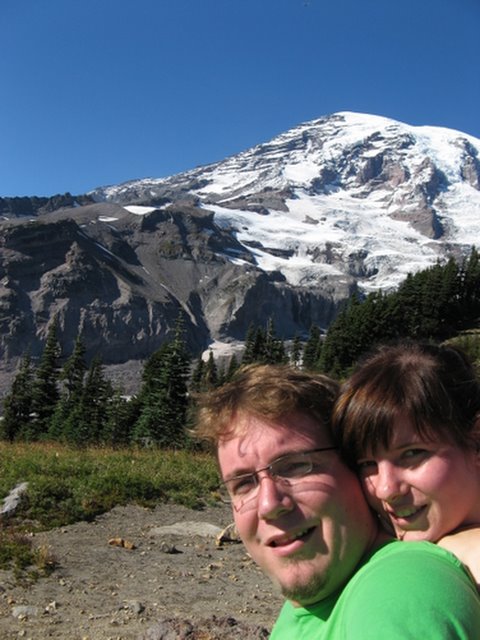
Lilifer Behrends and Timothy Hogg, Mount Rainier National Park, September, 2006 Posted by Picasa Read more!
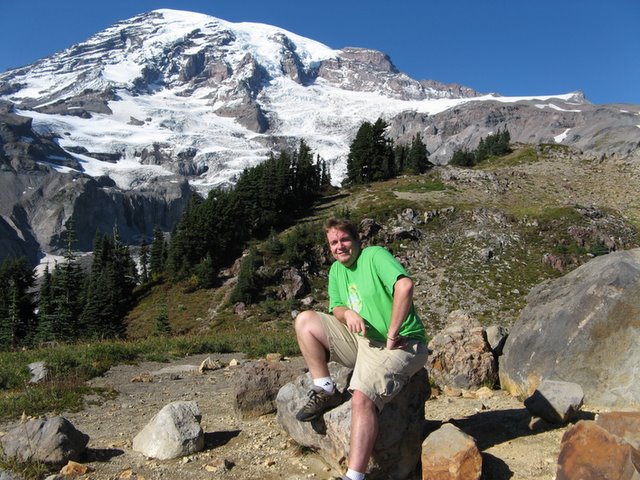
Finally the opportunity to upload some pictures of our recent adventures. The weather in Seattle has cleared enough for us to take some time out of the normal city life and see what Washington State has to offer. Mount Rainier National Park, a place I spent an entire summer at 13 years ago has hardly changed. The beautiful and historic Paradise Inn was under construction (much needed), so we headed up Panaramic Point for some breathtaking views of the mountain and its surroundings.
Here is a shot of me, Timothy Hogg, a dozen years later, still searching... Posted by Picasa Read more!

20 September 2006

The arrival

Things are starting to take shape, but the growing pains are showing, ever so slightly.
On friday, I managed to make it to the airport and pick Lili up--her bags didn't make it with her, but they did arrive with her in Philly--which meant simply that the Americans lost her bag--no big shocker there.
We spent the better part of the last five days basically domesticating ourselves and seeing where things lead--and I am happy to report that things are going fairly well. I am broke as hell right now as I have just purchased a new automobile and the down payment and the insurance went through at the same time--but at least they are paid for and I can now move on to the next stages of collecting other bills and paying off the old ones-- a lot of work ahead.
Things are going to be slightly complicated as I have a lot of little projects that I need to get started on and try as much as I can to keep Lili occupied while she is here--but all of these things seem like they will all resolve themselves in time.

The China story is being worked on- and it will be moved to a new blog location in the next week--this is where notes of the book are going to be turned into the long form for you, my dedicated readers....
If there are any left after my long hiatus.
Anyway, thats about all for now. Pics will come soon, I promise. Read more!

18 September 2006

110th Street (just tryin to survive)

It has been a two week hiatus since my last entry, which was a copy of a newstory. Sorry about that-- I guess the last two weeks have been more than slightly crazy as I have been working a lot and don't have the time or energy write anything on the blog after working on computers throughout the day.
I have moved into the new place, a nice apartment on 85th and Greenwood, which is a decent part of the city--still some color left in the neighbourhood and lots of things are very close to the apartment--lots of nice restaurants, grocery stores and even (gasp!) a Fred Meyer!
Lili has also arrived in Seattle--she arrived here on Friday, the 15th of September. So this is our third day together and she is sound asleep on the floor in the living room--the jet lag has finally caught up with her and it leaves me enough time to do a little writing and be focused for the time being.
This past weekend was a little crazy with the WSU football team coming in to town-- WSU vs. Baylor--and I am happy to say that we did win and I did not go to the game. WIth the new Lili in tow, I thought it might be a better idea to go out and enjoy the city, instead of going to a game and getting wasted beyond belief--there is always Apple Cup for that kind of thing....!

and YES, for those of you that are wandering, I am going to start working on the China stuff soon--a couple more weeks and the weather will be shitty once again and the time will be here to begin to write about my experiences writing once again.

For now, here are some pictures to see.. :) Read more!

28 August 2006

Experts warn U.S. is coming apart at the seams

By Chuck McCutcheon

Newhouse News Service

WASHINGTON — A pipeline shuts down in Alaska. Equipment failures disrupt air travel in Los Angeles. Electricity runs short at a spy agency in Maryland.

None of these recent events resulted from a natural disaster or terrorist attack, but they may as well have, some homeland security experts say. They worry that too little attention is paid to how fast the country's basic operating systems are deteriorating.

"When I see events like these, I become concerned that we've lost focus on the core operational functionality of the nation's infrastructure and are becoming a fragile nation, which is just as bad — if not worse — as being an insecure nation," said Christian Beckner, a Washington analyst who runs the respected Web site Homeland Security Watch (www.christianbeckner.com).

The American Society of Civil Engineers last year graded the nation "D" for its overall infrastructure conditions, estimating that it would take $1.6 trillion over five years to fix the problem.

"I thought [Hurricane] Katrina was a hell of a wake-up call, but people are missing the alarm," said Casey Dinges, the society's managing director of external affairs.

British oil company BP announced this month that severe corrosion would close its Alaska pipelines for extensive repairs. Analysts say this may sideline some 200,000 barrels a day of production for several months.

Then an instrument landing system that guides arriving planes onto a runway at Los Angeles International Airport failed for the second time in a week, delaying flights.

Those incidents followed reports that the National Security Agency (NSA), the intelligence world's electronic eavesdropping arm, is consuming so much electricity at its headquarters outside Washington that it is in danger of exceeding its power supply.

"If a terrorist group were able to knock the NSA offline, or disrupt one of the nation's busiest airports, or shut down the most important oil pipeline in the nation, the impact would be perceived as devastating," Beckner said. "And yet we've essentially let these things happen — or almost happen — to ourselves."

The Commission on Public Infrastructure at the Center for Strategic and International Studies, a Washington think tank, said in a recent report that facilities are deteriorating "at an alarming rate."

advertising

It noted that half the 257 locks operated by the Army Corps of Engineers on inland waterways are functionally obsolete, more than one-quarter of the nation's bridges are structurally deficient or obsolete, and $11 billion is needed annually to replace aging drinking-water facilities.

President Bush, asked about the problem during a public question-and-answer session in an April visit to Irvine, Calif., cited last year's enactment of a comprehensive law reauthorizing highway, transit and road-safety programs.

"Infrastructure is always a difficult issue," Bush acknowledged. "It's a federal responsibility and a state and local responsibility. And I, frankly, feel like we've upheld our responsibility at the federal level with the highway bill."

But experts say the law is riddled with some 5,000 "earmarks" for projects sought by members of Congress that do nothing to systematically address the problem.

"There's a growing understanding that these programs are at best inefficient and at worst corrupt," said Everett Ehrlich, executive director of the CSIS public infrastructure commission.

Ehrlich and others cite several reasons for the lack of action:

• The political system is geared to reacting to crises instead of averting them.

• Some politicians don't see infrastructure as a federal responsibility.

• And many problems are out of sight and — for the public — out of mind.

"You see bridges and roads and potholes, but so much else is hidden and taken for granted," said Dinges of the Society of Civil Engineers. "As a result, people just don't get stirred up and alarmed."

But a few politicians are starting to notice. In March, Sen. Hillary Rodham Clinton, D-N.Y., joined Sens. George Voinovich, R-Ohio, and Tom Carper, D-Del., in sponsoring a bill to set up a national commission to assess infrastructure needs.

That same month, the CSIS infrastructure commission issued a set of principles calling for increased spending, investments in new technologies and partnerships with business. Among those signing the report were Sens. Chuck Hagel, R-Neb., and Chris Dodd, D-Conn.

"Infrastructure deficiencies will further erode our global competitiveness, but with the federal budget so committed to mandatory spending, it's unclear how we are going to deal with this challenge as we fall further and further behind in addressing these problems," Hagel said in a speech last year. "We need to think creatively."

Read more!

21 August 2006

Yes, yes I know.
There is not much of an excuse for why I haven't been on here and doing things, but there have been a few mild challenges to writing, namely having anything worth any interest to recount. I am back and submerged in Americana again.
I am working at Microsoft, the work is challenging, but doable. The worst part about it is having to watch MSNBC throughout the day. I am considering starting a separate blog that focuses on things that the media reports and is actually incorrect information all together.
For instance, just last week, there were two seperate media incidents that transpired and the wrong information was reported.
First, it was the woman who had the plane grounded in Boston because she had a panic attack on the plane--then, almost immediatly, the press reported that she had various items of contraband on her along with possible terror connections, which turned out to be totally and completly untrue.
Next up we have Jon-Bonet's little love package, the freak from Bangkok who, we are now being told, was just recently laser shaved for his future sex change operation. Hmmmmm, now this guy had many, many, many hours of completly dedicated MSNBC television attributed directly to him and he basically said nothing at all, except that he, like the rest of us, loves Jonbonet. Oh, I too love her. I love her because she brings out what the media is really after, little suburban horror stories. As long as she isn't black and there is ample video of her, they will search and search for the killer--why? Because she is just like all of us, and if people wanted to see the real stories about the dark side of this American Life, they would watch Cops. That's reality.

So, as you can see, I am probably not going to start that blog, because whats the fucking point when it all comes down to it? People are perfectly content with simply adding little pieces of content to their myspace and calling it a day. No one really wants to think about the evil things that are happening in the world.... Read more!

09 August 2006

Sorry about the delay in communications--there is a lot going on right now.
I accepted the job at Microsoft and have been training and working for the last week. It is a new challenge in an area from which I have little experience and its showing... but most of the people that I work with are very cool and there are a couple of friends of mine from WSU that I work with in the "war room", so they keep me grounded.
In the next month, I will be getting a place and a car. Once these things happen, I am then going to work on the blog--once I get everything situated with the house--there is a lot of work to do--lots of writing to do, but I need to get my own personal space and time to do it. Once that happens, there will be some changes that happen here with the Blog--as to what those things are going to be, I am not sure just yet because for the most part these entries that you see are reminders of things for me to talk about in my current project.
Its nice to be working again and I look forward to the immense overtime that the job will bring. I hope to pay off a lot of the debts that have been hanging around ==but first I need to get a place to rest my head and some decent wheels. Read more!

29 July 2006

On Education Part II

Spending the last couple of days doing research for what I hope will be a book in the next year has taken into one of the pathways that I know will require a lot of research in the coming months.
The subject--higher education in China.
A large part of what I intend to write has a direct correlation to what the purpose of recruiting foreign teachers to teach at the University level in China is really for. From the time that I arrived in China, I was constantly wondering why they choose to spend so much time and effort recruiting foreigners (especially white American and British citizens) and then when we arrive, are not given any training about what we are to teach specifically.
Reading the different opinions about the Chinese educational system holds nearly as much propoganda as researching former Chinese leadership. However, it would seem that the main issue that the Chinese are dealing with when it comes to the aspect of higher education is a three fold issue.

First, the system since the Cultural reveloution has been full of corruption and deceit--which it developed during the Cultural reveloution because the schools were turned into breeding grounds for re-education in the sense of the newly formed Communist party, led by Mao. This system paid little to no attention in educating its pupils outside of its own idealogy. This cessation of education eventually (following the cultural reveloution), led to the discovery of potential gains from the development of a massive commodification of education.

Secondly, where as access was an issue before, the "college reveloution" soon took place and the chinese began to undertake a massive resugence of University development. For what purpose this was, I am still researching but my guess is two fold, First, this commoditification of education can become a cash cow quite easily. Those that sit at the top of the academic ladder in China are rarely academics, but moreso connected to the communist party--schools just become part of the machine. Families of all schools of thought, particularly Confucioun, believe that the way to sucess is through education. This, like it does elsewhere, works on all levels: if you work hard, do well is school, then you become rich. Its just that simple--but the fact of the matter is that its not that simple and will never be again.
Which is point three: The lack of new graduate positions in China is growing faster than ever before, but not fast enough. This past summer, more than 8 million people graduated from Chinese Universities, but there were less than 465,000 new jobs created in the country.
The offical Chinese line is as follows:
Chinese institutions of higher education admitted 5m students in 2005, sending the number of Chinese university attendees to 23m-the highest in the world. In order to maintain low teacher-to-student ratios and allocate the funds necessary to maintain high standards, Wen Jiabao, the Chinese premier, announced on May 10th that state councillors were mulling plans to reduce university admissions for the coming academic year. China faces a surplus of out-of-work graduates, according to the National Reform and Development Commission, which reports that 60% of students face unemployment upon graduation.

So, for now, this is what I am researching. My interest is to show the development of the educational system in a place like China...
Stay tuned... and try not to fall asleep. Read more!

Last Day in Chenzhou

These are the last photos of China.
At least the ones that were taken--as I go through and edit most of this over the coming months, in preparation for the book that I am planning to spend the next year on, I will hopefully be able to bring new pictures that missed the first round.
This is of what could be the ugliest baby I saw all year-- bless him.

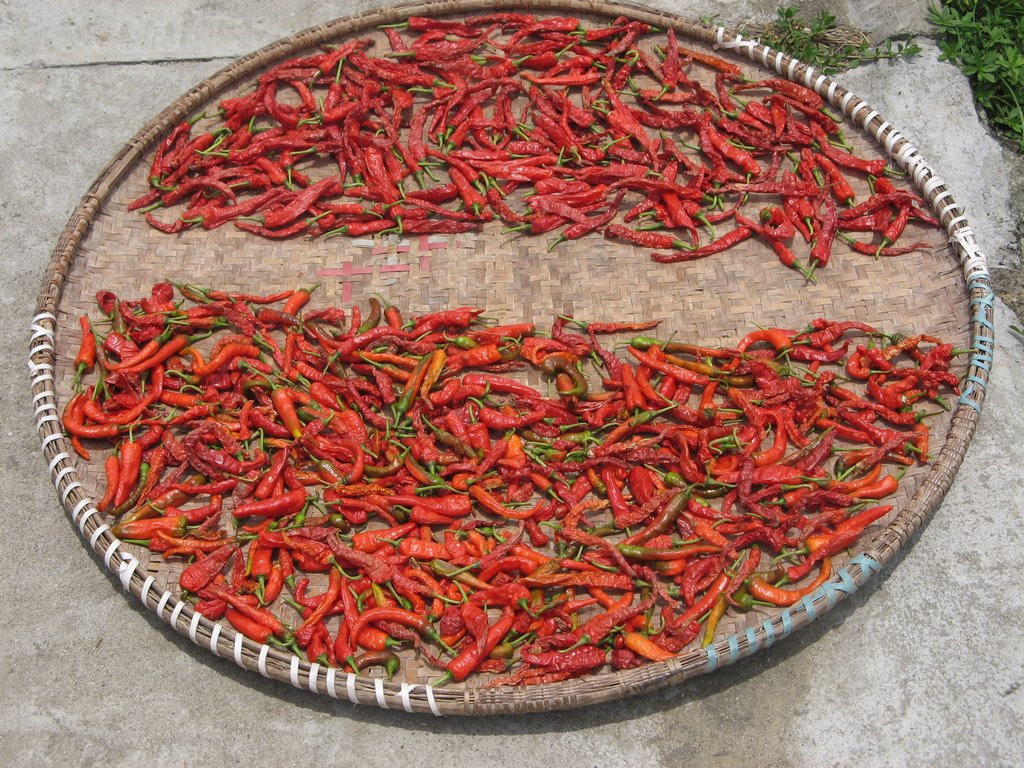
Red Hot Chili Peppers


Need I say more?


Chenzhou Mommas. Read more!

26 July 2006

First of all, I hate pop up ads.
By this time in the expansion of the net, a few things should have happened. First and foremost, people with pop-up ads should be put on a list and all people who use the net should boycott these products.
Next, I am working for about two hours each day until I start work at Microsoft next Tuesday working on the start of the Chinese experience. Its difficult to write!!!
I will more than likely be posting another blog site to work on it from while preserving this one as I think this chapter of my life is coming to a close. Not sure how its all going to work out at this point, but I am going to continue to post pics and comments to this site, with China specifically being this blog.
So, if you like China, stay tuned-- And boycott pop up ads.
:) Read more!

24 July 2006

Pearl Jam

I have been back in the country for exactly two weeks and I already have my first show completed. Last night, Pearl Jam played at the Gorge, in beautiful George, Washington. (See my previous posting on the Gorge).

2006-07-23
George
Washington
Gorge Amphitheatre
Download
Set 1
Severed Hand, Corduroy, World Wide Suicide, Gods' Dice, Animal, Do The Evolution, In Hiding, Green Disease, Even Flow, Marker In The Sand, Wasted Reprise, Better Man/(Save it for Later), Army Reserve, Garden, Rats, Whipping, Jeremy, Why Go
Encore 1
I Won't Back Down, Life Wasted, Big Wave, Satan's Bed, Spin The Black Circle, Alive
Encore 2
Given To Fly, Little Wing, Crazy Mary, Comatose, Fuckin' Up, Yellow Ledbetter

I will have to admit that from the excitement that had been building over the last couple weeks of the potential of going to the shows that I was slightly dissapointed by the overall experience.
Its not that I didn't like the show, but I have seen Pearl Jam in much better form. Several factors I think heightened this issue, the top factor being the overall heat at the Gorge. Upon our arrival at the gorge, it was well over 100 and didnt really cool down until nearly the end of the show.
Another major factor is that lawn seats just suck for a band like that. Part of the fun in seeing a Pearl Jam show is watching Eddie do his thing. Have a chance to see what hes thinking and doing.
The thing about Pearl Jam that I liked the most is they are near perfection on most of their songs and Eddies vocals don't sound much differently than they did more than a decade ago when 10 was first released.
Finally, lets face it. Seattle has this great, wonderful music scene, but the crowds suck here. There, I said it.
People just don't know how to really let loose at shows here. During Alive, there was not one crowd rider-- Hello? Its the song that really brought the concept of crowd riding into shows. There is nothing like floating through the air as Eddie shouts, "You're still ALIVE!!!"
but the fans last night, we clearly not as Alive as the song would like them to be.
Enviroment is a major factor is concerts and the Gorge just doesn't hold the magic that a solid indoor venue awards you. There are bands that are simply spectacular at the Gorge, like Dave Matthews, but Pearl Jam is all about the Arena rock sound. They would be much better playing a week straight at the Paramount in Seattle than three days at the Gorge.

I will post pics later. Read more!
The gorge is a funny place.
I remember going there a decade ago and it was this cool little venue in Eastern Washington. Over the years, I have seen it decline significantly with all of the different rules and policies it produces for the sole purpose of getting more revenue out of the concert goers.
Camping is probably the biggest offender. In the old days it simply used to a first come, first served camping situation and it was reasonable. Now, you can buy the tickets directly from ticketmonster and its expensive. A camping pass is over 30 bucks now for every night and most of the people that camp there do it loudly.
But this year, the other problems seem to have slightly corrected themselves. Last night at Pearl Jam, they allowed cameras and water to be brought it without any problem and there not police everywhere you looked.
Perhaps the gorge is learning that a few small changes might make people that the commute a little more often. Perhaps, I was just lucky and got some of the friendly people. Read more!

23 July 2006

Chenzhou Floods

Chenzhou Floods

Some terrible news has been coming in from my students. It seems that Chenzhou has been hit the hardest out of all of the provinces from the latest tropical storm. The details are sketchy right now, but it seems that the Chenzhou river overflowed and left a slick of sludge throughout the city. The rains were incessant and there were not many causualities in the city, the local townships and countryside seem to have massive caualities. I am trying to get word from my students about the flood, but they have been too responsive about it yet. Seems to be lucky that I got out of there when I did.
I will try to keep information updated as soon as I find out about it.... Read more!

14 July 2006

Getting back into the swing of things in Seattle can be a little harrowing. Just a week ago from today I was travelling from Chenzhou to Guangzhou to catch a plane back home. I have been home for a week and I am already thinking about what my next move is going to be. Basically, there are two options. The first is to pack my things up again and travel to Seoul, South Korea and become a teacher, again. The other is with Microsoft. At this point, I am attempting to keep myself excited about the Microsoft gig because it seems that I will get the offer any day.
I am currently working on going through the blog and taking notes as I am writing what might be the book version of my work. I will post bits of information from time to time concerning this, so please keep dialed in.
In the event that I do actually go to Korea, I will certainly post information on this site concerning that information. Read more!

10 July 2006

Seattle

Ahhh, its feels nice to be back on American soil once again.
Although it is difficult to say how long I will remain here. Already my thoughts are on the next move, which is looking more and more like it will be Korea. There is a big possibility of a job opening up at Microsoft, but if they don't manage to get things moving by the end of the week than I think I will more than likely just sign this contract and go to Korea for a year because it sounds like a nice job and pays well and I think another year out of the country will do me some good.
I can't say that I am overly impressed with being back--the food is nice and the weather is good, but its pretty much the same that it always here in Seattle and that is not such a good thing. After being through a year of such dynamice changes, it is hard to come back here and see that things are pretty much in the same realm as they always were before.
The thing that I keep thinking is that if things haven't really changed in a year, then its not going to be any different in another year.
Anyway, just a brief note to say hello and that all seems to be pretty status quo.
More later... Read more!

06 July 2006

Goodbye Chenzhou

5:08am
It is with mixed emotions that I write what will more than likely be my final blog entry in China. At about 2:30pm Beijing Standard time, I will leave Chenzhou for the last time in my career as a teacher here and head to Guangzhou for my last night in China. At about 830 tommorow morning, I will board Northwest Airlines to Tokyo and then to Seattle, arriving 15 minutes later at 8:45am. It will be the longest 15 minutes of my life.
The last week has been quite bittersweet as the days ticked by at an alarming rate. I watched the time pass before me as I sat and attempted to grade papers and spend time with Lili while she was here. We attempted to plot a course for the future, but only time will tell where we end up.
For now, my eye is focused on getting everything packed up that I have aquired in my year here in China and trying to get it back to America as cheaply as possible. I have not made a lot of money while I have been here, but I have tried to transfer the funds that I did make into things that will help me in remembering the parts of this trip that I really enjoyed.
The Chinese experience is a mixed bag of emotions and I find that any journey is always much more worthwhile if you live close to the edge. My time here has been both the best and the worst of times, but as I come to the end of this road, the most fond memories are what shines.

The part that is unfortunate is that most of the people who I really care for I will never see them again and they will probably never see this blog or any of the stories that I write about them because above it all, China is a closed society that appears to be opening up to the world, but its a seemingly long ways away from the freedoms that we Americans enjoy each and every day.

I have all but accepted another position as a teacher just outside of Seoul, so if everything goes according to plan, I will be in Seattle for about two or three weeks and then it will be off to Korea for another year of teaching. Teaching for the next year is more of a ways to meet an end before coming back to the states and considering what the next move is going to be. When it came down to looking for a position, the Korean transaction was simple. Its amazing how tiresome it gets to send out resume and cover letter after cover letter and not get any response whatsoever. In Korea, there will be good money and a neutral, new ground for Lili and I to explore together. So, hopefully it will all work out.

But for now, the next 24 hours are going to be about completing the final journey in one of the few places on earth that something as simple as catching a flight can somehow become an adventure. The journey itself will be long--4 hours to Guangzhou, 3 hours to check in before the flight and then 24 hours of travel before arriving back in latteland.
And man am I excited to come home. Real coffee, real beer, real food. Salmon, halibut, burgers, steaks, friends, new kids, etc...

Goodbye Chenzhou, I'm leaving today.... Read more!

25 June 2006

Red China...
About the only true red that one tends to see anymore is the red eyes from the male dominated Bijuo dinners. China is no longer full of the reds as Americans once feared. No, the reds have been replaced by the almighty capitalists consumption and each time I visit a new city I see more and more of the same thing, rows and rows of shops selling horrible clothes at prices that these people cannot afford, and the shops are not full of the people that are briskly walking down all of the streets.. Lots of window shopping but so little of the real spending that one wonders how the shops actually manage to keep themselves in business.
Perhaps it is like this because of low overhead, but there seems to be something else totally amiss about the Chinese and their idea of socialism. It is just very difficult to quantify all of it together and come up with a valid theory.
Here is what is at issue
1. Most of the people in this country are dirt poor.
2. This system should work that everyone is taken care of, no matter what the cost because it is the People´s Republic.
3. The public officials that are supposed to be providing the services for the people are not poor, but they are driven around in Audi´s, Volkswagon´s and Mercedes.
4. The concept of the amarketplace is being driven out by the mall concept because the less than acceptable merchants are individuals, not corporation.
5. The use of propoganda to the people is of astronomical levels. The World Cup is the greatest example of this. Before the world cup, never any mention of soccer anywhere. The football pitch was usually empty. Now that World Cup fever is here on the tele, it is amazing to see just how these people act like they have enjoyed the sport for all of these years.
And there is more, but I must say good night... Hard to believe its one of my final days here in Hunan. Read more!