07 June 2005

If only George W. Bush was his neighbor!!

Man with a chain saw that was apparently covered with blood was let into the U.S.

Gregory Despres is shown in this image from television. On April 25, 2005, Despres arrived at the US-Canadian border crossing at Calais, Maine, carrying chain saw stained with what appeared to be blood, a homemade sword, a hatchet, a knife, and brass knuckles.
Gregory Despres is shown in this image from television. On April 25, 2005, Despres arrived at the US-Canadian border crossing at Calais, Maine, carrying chain saw stained with what appeared to be blood, a homemade sword, a hatchet, a knife, and brass knuckles. (AP Photo)

BOSTON (AP) -- On April 25, Gregory Despres arrived at the U.S.-Canadian border crossing at Calais, Maine, carrying a homemade sword, a hatchet, a knife, brass knuckles and a chain saw stained with what appeared to be blood. U.S. customs agents confiscated the weapons and fingerprinted Despres.

Then they let him into the United States.

The following day, a gruesome scene was discovered in Despres' hometown of Minto, New Brunswick: The decapitated body of a 74-year-old country musician named Frederick Fulton was found on his kitchen floor. The man's head was in a pillow case under a kitchen table. His common-law wife was discovered stabbed to death in a bedroom.

Despres, 22, immediately became a suspect because of a history of violence between him and his neighbors, and he was arrested April 27 after police in Massachusetts saw him wandering down a highway in a sweat shirt with red and brown stains. He is now in jail in Massachusetts on murder charges, awaiting an extradition hearing next month.

At a time when the United States is tightening its borders, how could a man toting what appeared to be a bloody chain saw be allowed into the country?

Bill Anthony, a spokesman for U.S. Customs and Border Protection, said the Canada-born Despres could not be detained because he is a naturalized U.S. citizen and was not wanted on any criminal charges on the day in question.

Anthony said Despres was questioned for two hours before he was released. During that time, he said, customs agents employed "every conceivable method" to check for warrants or see if Despres had broken any laws in trying to re-enter the country.

"Nobody asked us to detain him," Anthony said. "Being bizarre is not a reason to keep somebody out of this country or lock them up. ... We are governed by laws and regulations, and he did not violate any regulations."

Anthony conceded it "sounds stupid" that a man wielding what appeared to be a bloody chain saw could not be detained. But he added: "Our people don't have a crime lab up there. They can't look at a chain saw and decide if it's blood or rust or red paint."

Sgt. Gary Cameron of the Royal Canadian Mounted Police would not comment on whether it was, in fact, blood on the chain saw.

On the same day Despres crossed the border, he was due in a Canadian court to be sentenced on charges he assaulted and threatened to kill Fulton's son-in-law, Frederick Mowat, last August.

Mowat told police Despres had been bothering his father-in-law for the past month. When Mowat confronted him, Despres allegedly pulled a knife, pointed it at Mowat's chest and said he was "going to get you all."

Police believe the dispute between the neighbors boiled over in the early-morning hours of April 24, when Despres allegedly broke into Fulton's home and stabbed the couple.

Fulton's daughter found her father's body two days later. His car was later found in a gravel pit on a highway leading to the U.S. border. Despres hitchhiked to the border crossing.

After the bodies were found on the afternoon of April 26, police set up roadblocks and sent out a bulletin that identified Despres as a "person of interest" in the slayings, according to the Royal Canadian Mounted Police.

The bulletin caught the eye of a Quincy police dispatcher because it gave the suspect's Massachusetts driver's license number, missing a character. The dispatcher plugged in numbers and letters until she found a last known address for Despres in Mattapoisett. She alerted police in that town, and an officer quickly spotted Despres.

In state court the next day, Despres told a judge that he is affiliated with NASA and was on his way to a Marine Corps base in Kansas at the time of his arrest.

After the case was transferred to federal court, Despres' attorney, Michael Andrews, questioned whether his client is mentally competent.

Fulton's friends in Minto, a village of 2,700 people, told the New Brunswick Telegraph-Journal that he was a popular musician, a guitarist known as the "Chet Atkins of Minto" and a 2001 inductee in the Minto Country Music Wall of Fame.

Read more!

06 June 2005


Megan, Megans Mom and the Fargo. Posted by Hello Read more!

This chick was called sherbert pants by our group for her lime green capris. Fucking hilarious. Posted by Hello Read more!

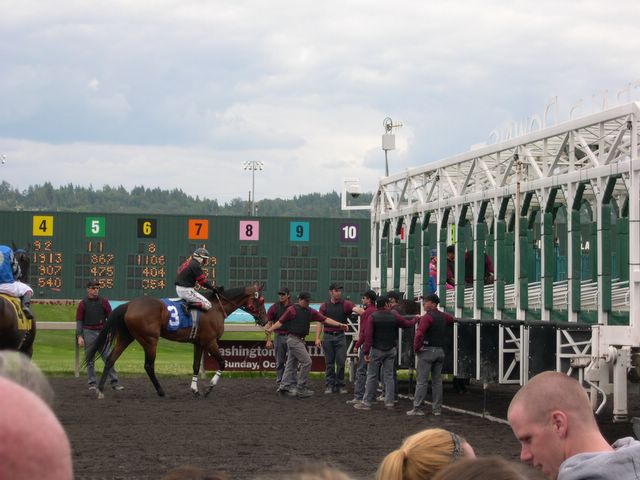
How much do Jockeys make?  Posted by Hello Read more!

This jockey had his 800th win. He didn't really enjoy all the attention he was getting for it, but it was comical to watch these people make a big deal out of it. Posted by Hello Read more!

Emerald Downs Race Track is whack! Read more!

What a day for the ponies!!! Read more!

05 June 2005


The famous John Steward catching up on some thinking. Read more!

Feet First's Fearless Leader David working on the bus while I was snoring! Read more!

Me outside of the Marcuse Dance Studio where we had a great catered meal provided by choices market... Mmmmm good. Read more!

The False Creek ferries-- we rode these over to Yale town. Read more!

Read more!

Read more!

Watching the PI reporter jot some notes down. (She was doing this the whole time Gord spoke!) Read more!

Listening to bit more about the city trip we are about to go on. People from Allied Arts, the PI, Vulcan and SDOT are all pictured here. Read more!

The Train station-- We took the Amtrak up from Seattle. Read more!

Gordon Price, fearless tour leader and his assistant for the day. Read more!

These are all various shots from the developing the walkable city tour that we took of Vancouver on 06.03.05. Read more!

Feet First Developing the Walkable City

On Friday, the event that I have spent the last several months working on came to an end with a bash. Developing the walkable city was an event designed to take a group of developers, community members, government people, etc up to vancouver to see how a place like Vancouver develops itself into the community that it is today.
For me, I think the experience was different than most that went on the tour because I have more of a love for Vancouver than most any other city that I have lived in or visited more than a couple of times. To me, Vancouver represents the idea city. A little expensive, but also very user friendly.
Seattle, has the potential to be so much more than Vancouver in a number of ways, but the problem has always seemed to be the same--the people in charge of making decisions do not actually do so, politicians do not form together and set a list of common goals to move the city in a positive direction--instead, they seem to sit ideally by and let process take precidence over judgement.
Developers need to be lobbied by community leadership that will say that you can build smartly, the city will cooperate if you build with intellegent design. It is an interesting parellel to get involved in. Developers want to develop land to make money. Community leaders want smart developments that allow for a stronger community process to take place. Politicans want to make sure that process is followed and that the people are heard through their elected leadership. Seems easy enough on paper, but the difficulty is getting all the different people together to work out smart resolve. Going on this trip showed where the difficulty comes in and most of it comes from the personality and career angles. To be realisitic, developers are not going to listen to non-profits if they dont have to because they speak a different language. A developer would not mind building pedestrian friendly buildings if they were able to make more money and not have to deal with as much regualtion, but it seems as soon as people are ready to pay attention to developing smart projects, then everyone with a cause comes a knockin and it holds up the process.
What seems to need to happen is that a coalition needs to be formed that takes into account public input regarding proposals to the city to speed up their process. Once these two colloborate, the next step is to work with government to move process along.
Seattle needs to make some major changes downtown if it ever plans to grow.

I will be adding more to this in the future, but I am excited to add the pics and go riding today, so I must rap this up. Read more!

30 May 2005

Community Supported Ag

The Business of Food: CSAs for Singles
Health! Self-esteem! Romance! All just a carrot away!

by Ritzy Ryciak


Good, good for you, and pretty to boot.
(Karen Steichen)


Even if you eat out five days a week, you've probably at least heard about CSAs. Community- supported agriculture is a rapidly growing movement to directly connect local food producers with urban consumers through weekly shipments of what's freshest and best of the season. There are already more than 70 farms in Washington state shipping to subscribers, who pay either a lump sum or in installments through the season, thereby securing the farmers a guaranteed market and a fair price and assuring a supply of first-rate produce for buyers.

There's just one problem with CSAs, and it's a big one. Most such programs are designed for that statistically average family of four, and among urban households, that number's just not statistically average any more. We may be tempted when listening to friends who are members of a CSA rave about their weekly baskets overflowing with seasonal, organic, and local food that absolutely tastes better. But for a lot of us, a weekly overflowing basket is just too much food. How can singles successfully join the CSA movement?

"A lot of people ask me that question," affirms Matt Ewer, general manager of the Full Circle Farm, a 140-acre certified organic farm in Carnation. One solution's obvious: "Many single people will come in, share a box, and cut their cost." But sharing can be tricky, giving rise to misunderstandings and bickering. Full Circle offers another option: three different basket sizes— small, medium, and large—and a way for customers to skip a basket at any time.

Full Circle Farm, which operates year-round, offers a flexible membership program. Members can sign up for a week or a year, and everything can be done online. "Belonging to Full Circle's CSA is very easy and affordable because you pay by the box," explains Elizabeth Blessing, a single, 27-year-old nutrition educator and Full Circle Farm CSA member. "I tried to join another CSA once, and I just couldn't pay that bulk sum at the beginning of the season." A full-season subscription can run as high as $600 for a weekly family-of-four box. Full Circle's flexi-boxes, by contrast, run $25 to $45 per week, with every-other-week packages available as well.

"Basically, through technology, we have been able to make our program more accessible," says Ewer, referring to the Full Circle Web site that allows members to vary the size of their basket and its contents on a weekly basis. "Our program is based on customer flexibility."

Gerrie LaQuey, a 52-year-old single nurse and Pike Place Market Basket CSA member for four years, tackles the CSA quantity dilemma by canning, freezing, and drying her seasonal produce. The Pike Place Market Basket CSA program runs from June to October, but LaQuey eats the local produce year-round. "Be creative," says LaQuey. "The produce is too good not to join. Don't be daunted by the size—it may be a good opportunity to meet a neighbor or learn a new skill."

For some, sheer quantity turns out to be a nonproblem. Many first-time CSA singles report that they inevitably eat more fresh vegetables and end up feeling healthier. A.J. Lowe, a single UW employee and a Full Circle Farm CSA member for a year, noticed a dramatic increase in energy and has had no problems eating through her weekly basket. "I use every bit of the food up," she exclaims. "I have even started cooking with the radish greens and the leaves on top of carrots. I just love them!"

Though sharing has its hazards, many see it as a bonus. "One of the great things about this way of eating is that we are trying to encourage community," offers Michele Catalano, program manager of the Pike Place Market Basket CSA. "A lot of people share with other singles or other couples, and it's a great way to not isolate yourself at the grocery store. I always look at CSAs as a way to bring people together."

Tyler Kalberg, a single, 25-year-old Tacoma resident, joined Pike Place Market Basket CSA to support local farmers and expand his fruit and vegetable palette."I also really don't like to go grocery shopping," admits Kalberg, who is sharing his basket with a friend from work and her husband.

Single or not, it is hard to find an unhappy CSA member. With improved technology, basket sharing, and more than 20 CSA options to choose from in the Seattle area, joining the CSA movement is feasible and rewarding for those of us who live and nibble alone."I think that a single person benefits from CSAs in the same way that families do," offers Ewer. "CSAs take the middleman out. You get a better price from your food and a fresher product. The food also has a meaning behind it, which is to support local farms in your own community."

info@seattleweekly.com

Read more!